CP-80
Electric Grand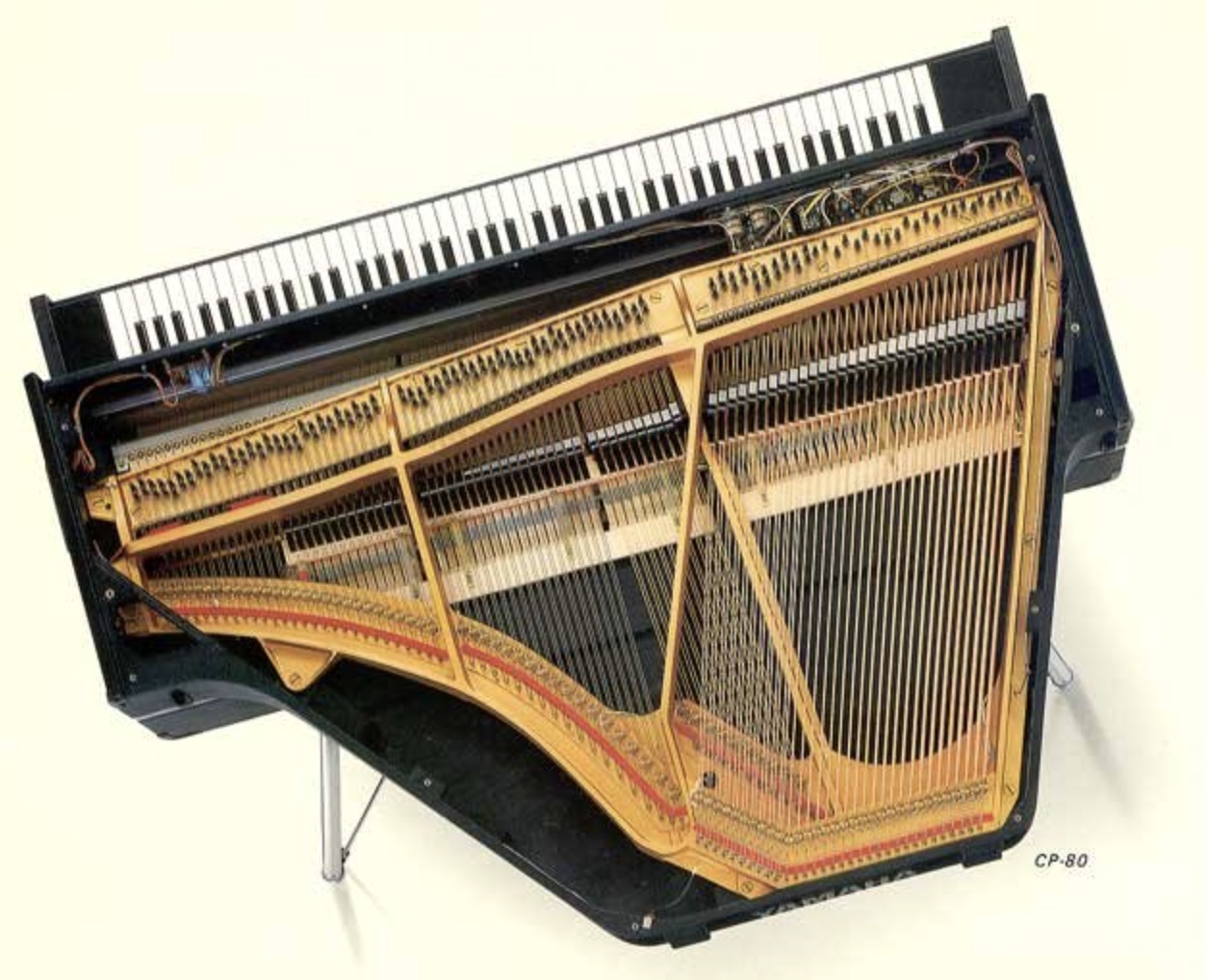
A physical model, not a sample library. The plugin solves struck strings in real time — stiffness, hammer contact and the piezo bridge pickup that gave the CP-80 its bite. The browser page runs the same model through WebAssembly, with the rendered bank kept as a fallback.
Play the live model in your browser →
Velocity: the reference pack has four recorded layers — PP 1–49, MP 50–81, F 82–103 and FF 104–127. The live model remains continuous between them; the browser fallback follows those exact sample boundaries.
Download
- macOS VST3 · Audio Unit · Standalone — universal, signed & notarised →
- Windows VST3 · Standalone — 64-bit →
- Linux VST3 · Standalone — x86-64 →
Free and open source under the AGPLv3. Build it yourself from the source — the engine is a single header with no dependencies.
What it is
Stiff strings
The CP-80's strings are short and under enormous tension, so their partials stretch sharp far faster than a concert grand's. That inharmonicity is the instrument's signature, and it falls out of the physics rather than being dialled in.
Hammer contact
A nonlinear felt-and-urethane contact law with rate hardening. Hit it harder and the contact gets shorter and stiffer, so the tone brightens the way a real hammer does — no velocity crossfades. With sustain, a same-pitch retrigger meets the already-moving string state instead of spawning a fresh zero-state string.
Piezo bridge
Output is read as force at the bridge, exactly where the real pickups sit. It is why the model sounds electric rather than acoustic, and why it needs no corrective EQ.
The panel
Volume, a three-band tone stack with a centre detent, the three-position brilliance switch, and the tremolo — antiphase across the stereo field, as the original's twin amplifiers were wired.
Requirements
macOS 11 or later (Apple silicon and Intel) · Windows 10 or later · Linux with ALSA or JACK. Roughly 9% of one core with all 24 voices sounding. Yamaha and CP-80 are trademarks of Yamaha Corporation; this project is not affiliated with or endorsed by Yamaha.